DTF Printing Business Cost in India: Complete Breakdown
Part of our guide: What Is DTF Printing? A Complete Beginner's Guide for India
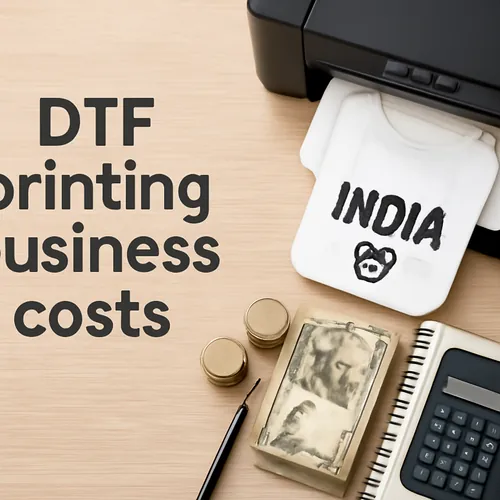
The cost of a DTF printing business in India comes from nine areas: the DTF printer, powder shaker and dryer, heat press, consumables, space and electricity, staff, software and computer, marketing, and working capital for blanks and running expenses. The printer is the biggest single cost, but monthly running costs decide whether you make money. This guide lists every cost category, shows how to calculate your cost per print with a worked example, and explains break-even, so you can plan with your own numbers.
If you are new to how DTF works, read our complete beginner’s guide to DTF printing first.
Important: we do not quote machine prices here because they vary widely by size, brand, dealer and import cost, and they change often. All rupee figures below are made-up example numbers to show the method. Use real quotes from your suppliers.
What are the start-up costs of a DTF business?
1. DTF printer
Your biggest purchase. The main choice is size:
- A3 desktop printers: lower investment, lower output, often used for testing or small orders.
- Roll-fed printers (wider format): higher investment, much higher output, usually paired with an automatic shaker and dryer.
Also budget for the RIP software (sometimes included), spare printheads or a service plan, and installation and training. Our guide to DTF printers in India from budget to premium compares the categories.
2. Powder shaker and dryer (or curing oven)
After printing, the film needs adhesive powder and curing. A3 setups often use manual powdering and a small curing oven. Roll setups use an automatic shaker and dryer, which saves labour but adds cost and power use.
3. Heat press
Transfers the cured film to the garment. Choose a plate size that fits your largest print (oversize T-shirts need a bigger area) and a press with even heat and an accurate timer. Busy shops often have two presses so pressing does not slow down printing.
4. Computer, software and design tools
A computer that can run the RIP and design software smoothly, plus any software subscriptions. Add a UPS to protect the machines from power cuts.
5. Space setup
Rent and deposit if you take a unit, plus electrical work, ventilation (curing gives off fumes), work tables, shelves and storage for blanks.
What are the monthly running costs?
| Cost category | What it includes | Fixed or variable |
|---|---|---|
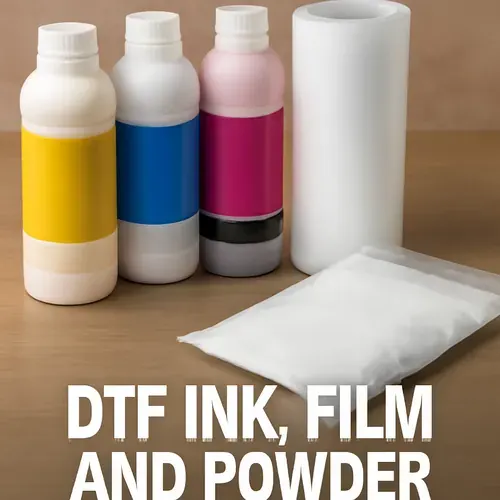
| Consumables | Ink (CMYK + white), PET film, adhesive powder, cleaning solution | Variable (per print) |
| Blank garments | T-shirts, hoodies, polos in each size and colour | Variable |
| Packaging | Polybags, labels, boxes, tags | Variable |
| Electricity | Printer, dryer or oven, heat press, AC/fans | Mostly variable |
| Rent | Shop or unit rent, maintenance | Fixed |
| Staff | Printer operator, presser, packer | Mostly fixed |
| Maintenance | Printhead care, parts, service visits | Semi-fixed |
| Software | RIP, design tools, store or app subscriptions | Fixed |
| Marketing | Instagram and Meta ads, samples, photoshoots | Flexible |
| Shipping and fees | Courier, COD charges, marketplace commission, returns | Variable |
| Working capital | Cash for stock and costs before customers pay | One-time buffer |
Do not forget working capital. Marketplace payouts and COD collections take time to reach your account, so you need cash to keep buying blanks and paying staff in the meantime. Plan for a few months of running costs.
How do you calculate DTF cost per print?
Add up everything that goes into one printed T-shirt:
- Print consumables: film + ink + powder for that design size.
- Electricity per piece: total power bill share ÷ pieces made.
- Labour per piece: monthly staff cost ÷ pieces made.
- Wastage: test prints, misprints and reprints (add a percentage).
- Blank garment and packaging.
Worked example (hypothetical numbers only)
Say you print one A4-size front design on a cotton T-shirt:
| Item | Example cost (₹) |
|---|---|
| Film | 12 |
| Ink (CMYK + white) | 14 |
| Adhesive powder | 4 |
| Electricity share | 3 |
| Labour share | 10 |
| Wastage allowance (about 10%) | 4 |
| Print cost | 47 |
| Blank T-shirt | 180 |
| Packaging | 15 |
| Cost per finished piece | 242 |
These are illustrative figures, not market prices. Your real cost changes with design size, ink coverage, film quality, your power tariff and how many pieces you print per month (labour and power per piece fall as volume rises). Shipping, COD charges, marketplace fees and returns come on top.
How do you work out break-even?
Break-even is the number of pieces you must sell each month to cover fixed costs:
Break-even pieces = monthly fixed costs ÷ (selling price − variable cost per piece)
Example with made-up numbers: monthly fixed costs (rent, salaries, software, base marketing) = ₹40,000. Selling price = ₹449. Variable cost per piece including shipping and fees = ₹330. Margin per piece = ₹119.
40,000 ÷ 119 ≈ 336 pieces a month, or about 11–12 pieces a day, just to cover monthly costs.
Only after that does your machine investment start to pay back. If your equipment cost ₹4,00,000 in this example, you would need roughly 3,360 extra pieces (4,00,000 ÷ 119) beyond break-even to recover it. This is the most important number to check before buying, because idle machines still cost rent, salaries and EMIs. Try your own figures in our profit calculator.
What are the hidden costs people forget?
- Printhead replacement if the white ink clogs.
- Failed prints while you learn the settings. Our step-by-step DTF printing process helps reduce early mistakes.
- Unsold blanks in slow sizes and colours.
- Return-to-origin (RTO) losses on COD orders.
- Power cuts and the cost of a backup supply.
- Your own time on printing instead of selling.
For a wider view of other equipment, see top printing machines for small businesses in India.
Is there a zero-machine alternative?
Yes. With print-on-demand, a partner owns the DTF printers, presses and stock, and prints each order after your customer buys. Your start-up costs drop to design, your store and marketing.
| Own DTF setup | Print-on-demand with PrintzyHub | |
|---|---|---|
| Machines | You buy them | None needed |
| Blank stock | You buy and store it | Not needed |
| Minimum order | Your choice, but idle time costs money | No minimum order |
| Printing, packing, shipping | You and your staff | PrintzyHub, under your brand |
| Cost per piece | Falls with high volume | Base price per piece |
| Best for | Proven, steady demand | Testing designs, new brands, marketplace sellers |
With PrintzyHub, you sign up free in the app, pick a product, upload artwork and sell on your own store or on Amazon, Flipkart, Meesho or Myntra. We print with DTF, run quality control on every order, and pack and ship under your brand. See current base prices on our pricing page. For the full roadmap, read how to start a print-on-demand business in India, or browse more low-investment printing business ideas in India.
Conclusion
A DTF business needs more than a printer: shaker and dryer, heat press, consumables, space, power, staff, software, marketing and working capital all add up. Calculate your cost per print and break-even with real quotes before you buy. If the numbers depend on sales you do not have yet, start with print-on-demand, prove your designs sell, and invest in machines when the orders justify it.
Next step: create a free PrintzyHub account and launch your first designs without buying a single machine.
Frequently asked questions
How much does it cost to start a DTF printing business in India?
It depends mainly on the printer size you choose and whether you rent space and hire staff. A small A3 setup run from home costs far less than a roll-fed printer with an automatic shaker and dryer in a rented unit. Get at least three current quotes from Indian suppliers and add consumables, blanks and a few months of running costs before you decide.
Is a DTF printing business profitable in India?
It can be, if you have steady orders. The machines only pay for themselves when they run regularly, so the real question is whether you can sell enough pieces each month to cover fixed costs. Calculate your break-even quantity before buying.
What is the running cost of a DTF printer?
Running costs include ink, PET film, adhesive powder, electricity, cleaning solution, printhead maintenance and wastage from test prints and failed transfers. White ink also needs regular circulation or printing so it does not settle and clog the head.
Can I start a DTF business from home?
Small A3 DTF printers are used from home by some sellers, but you need good ventilation for curing, a stable power supply, enough space for the press and stock, and local rules to allow it. Many people instead start with print-on-demand from home and move to their own machines later.
Do I need GST registration for a DTF printing business?
You need GST registration if your turnover crosses the threshold, and usually also to sell on marketplaces like Amazon, Flipkart, Meesho and Myntra. Rules and rates change, so confirm the current requirements with a CA.