DTF Ink, Film and Powder Explained: How to Choose and Store Them
Part of our guide: What Is DTF Printing? A Complete Beginner's Guide for India
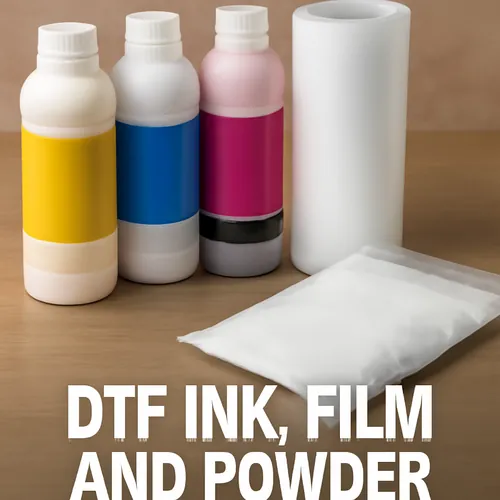
DTF printing uses three consumables: pigment ink (CMYK plus white), PET transfer film, and hot-melt adhesive powder. The ink carries the design, the film holds it until pressing, and the powder is the glue that bonds the print to the fabric. Choosing compatible, good-quality consumables and storing them properly solves a large share of DTF quality problems before they happen.
New to DTF? Our beginner’s guide to DTF printing explains the whole method first.
What is DTF ink and how is it different?
DTF ink is a water-based pigment ink made for textile transfers. Pigment particles sit on the film and later bond with the adhesive powder, which gives good colour strength and wash resistance.
A DTF printer uses five colours:
- Cyan, magenta, yellow and black (CMYK) for the design itself
- White as a base layer printed over the colours
Why white ink needs special care
White ink uses a heavy pigment (commonly titanium dioxide) that settles to the bottom of tanks and lines. If it settles inside the print head, it clogs nozzles. That is why DTF machines have white ink circulation or agitation, and why operators shake white ink bottles and run cleaning routines daily.
How to choose DTF ink
- Choose ink made for your print head type. Many DTF printers use Epson-type heads, and ink is formulated for them.
- Look for a matching ICC profile or RIP settings from the supplier.
- Check that the white is opaque enough to cover a black T-shirt in one pass.
- Buy from a supplier in India who can tell you the batch date and shelf life.
- Avoid switching brands often. Mixing inks in the same system can cause clogs.
What does DTF film do?
DTF film is a PET (polyester) film with a special coating on one side. The coating holds the wet ink in place so it does not bead or spread, and later releases it cleanly onto the garment.
Types of DTF film
| Type | How it works | Good for |
|---|---|---|
| Hot peel | Peel straight after pressing | Fast production runs |
| Cold peel | Peel after the film cools fully | Fine detail, slightly glossy finish |
| Warm peel | Peel a few seconds after pressing | A middle ground |
| Sheets (A4, A3) | Cut sheets for desktop printers | Small studios, testing |
| Rolls (around 30 cm or 60 cm wide) | Continuous rolls for roll-to-roll printers | Higher volume |
Some films are coated on one side only; others have an anti-static or textured back so they feed better.
How to choose DTF film
- Match the peel type to your workflow and keep it the same across a job.
- Check the coating: ink should sit evenly without beading or pooling.
- Look for even thickness and no curl, which helps feeding and powdering.
- Test the release. Good film peels cleanly with no ink left behind.
What is DTF powder and which grade should you use?
DTF powder is a hot-melt adhesive, most often based on TPU (thermoplastic polyurethane). It sticks to the wet ink, melts during curing and then bonds the print to the fabric during pressing. The powder is what makes the print stretch and survive washing.
Powder grades
| Grade | Typical use | Feel |
|---|---|---|
| Fine | Detailed designs, thin fabrics, small text | Softest |
| Medium | Most T-shirts and everyday work | Balanced |
| Coarse | Heavy fabrics like fleece, canvas, thick hoodies | Strongest bond, slightly thicker |
| Black / anti-migration | Dark polyester where dye can bleed into white | Reduces dye migration |
Most Indian T-shirt businesses start with a medium grade and adjust from there.
How to choose DTF powder
- Melt quality: it should cure into a smooth layer without bubbles.
- Stretch: pressed prints should stretch with the fabric and not crack.
- Wash performance: test-wash a few garments before committing to a supplier.
- Consistent grain size from batch to batch.
How do ink, film and powder work together?
The three consumables form one system. The film coating has to hold the ink without beading. The ink has to stay wet long enough for powder to stick. The powder has to melt fully at your curing temperature and bond with both the ink and the fabric.
When one part does not match, you see problems like powder not sticking, prints peeling after washing, or ink smudging on the film. Our list of common DTF printing problems and solutions links each of these to a cause. The detailed step-by-step DTF printing process shows where each consumable is used and the typical curing and pressing settings.
How should you store DTF consumables in India?
Indian weather is hard on DTF supplies. Heat in summer and humidity in the monsoon both cause trouble.
Ink storage
- Store bottles upright in a cool, shaded place, away from direct sunlight.
- Keep caps tightly closed so ink does not dry or collect dust.
- Shake white ink well before topping up tanks.
- Use older stock first and watch the expiry date.
Film storage
- Keep film in its original sealed packet or bag until use.
- Store flat or on its roll core, away from moisture.
- Handle by the edges; skin oil and dust on the coating cause spots.
- In humid months, let film settle in the air-conditioned print room before use.
Powder storage
- Use an airtight container and add a silica gel packet.
- Close the lid immediately after powdering.
- Sieve powder that has started to form small lumps, or replace it.
- Keep it away from heat sources such as the curing oven.
Printed transfer storage
- Store cured transfers flat, separated by parchment paper, in a sealed bag.
- Keep them out of humidity and press them within the time your supplier suggests.
What does this mean for your business?
Consumables are an ongoing cost, not a one-time purchase. Ink, film and powder are used on every print, and white ink is used generously. Waste from test prints, clogs and failed transfers adds to that cost. Our cost breakdown to launch a DTF printing business in India explains how to include these in your planning.
How PrintzyHub helps
If you want DTF-printed apparel without managing ink stock, film rolls and powder humidity, PrintzyHub does the printing for you. You upload your design on the app, and PrintzyHub prints with DTF, checks quality, packs and ships each order under your brand, with no minimum order. Browse blanks like the round neck T-shirt and sweatshirt or see the full range and current base prices on the catalog page.
Conclusion
DTF ink, film and powder work as one system. Choose ink suited to your print heads, film with the right peel type and a clean coating, and a powder grade that fits your fabric. Then store all three away from heat and humidity, and test whenever you change a supplier.
Next step: want to see what a well-made DTF print feels like? Order a sample from PrintzyHub and check the print yourself.
Frequently asked questions
Can I use normal printer ink for DTF printing?
No. DTF needs pigment ink made for textile transfers, including a white ink. Regular dye or photo inks do not bond with the adhesive powder, crack on fabric and fade quickly in washing.
Which DTF powder grade should I use?
Medium powder is a good all-round choice for most T-shirt work. Fine powder suits detailed designs and lighter fabrics, while coarse powder is used for heavy fabrics like fleece, canvas or thick hoodies. Black powder is sometimes used on dark polyester to reduce dye migration.
Why does my DTF powder form lumps?
DTF powder absorbs moisture from the air. In humid weather, especially during the Indian monsoon, it clumps and stops spreading evenly. Store it in an airtight container with a desiccant and keep the lid closed between uses.
How long does DTF ink last?
Most DTF inks have a shelf life printed by the manufacturer, often around a year unopened when stored correctly. Once opened, use it within the time the supplier advises and keep it away from heat and direct sunlight. White ink needs regular shaking because its pigment settles.
Do I need to match ink, film and powder from the same brand?
Not always, but they must work together. Mixing random brands can cause ink beading, poor powder adhesion or peeling. If you change one consumable, test it with your current setup before running a full order.