Best DTF Printers in India: A Buying Guide from Budget to Premium
Part of our guide: What Is DTF Printing? A Complete Beginner's Guide for India
The best DTF printer in India is the one that fits your daily volume and comes with reliable local service, not simply the cheapest or the biggest. For most small businesses, the choice is between an A3 desktop DTF printer, a 30 cm roll-to-roll machine, and a 60 cm roll-to-roll machine with a powder shaker-dryer. This guide explains each category, what to check before you buy, the real running costs, and when using a print partner makes more sense than owning a machine.
Machine models and prices change quickly, so instead of a list that goes out of date, we focus on how to judge any DTF printer you are offered. If you are new to the method, read our beginner’s guide to DTF printing first.
What types of DTF printers are available in India?
DTF printers fall into a few clear categories by size and automation.
| Category | Typical print width | Powdering and curing | Suits |
|---|---|---|---|
| Converted A4 desktop | A4 sheets | Manual (tray + oven or press) | Learning, very small orders |
| Converted or dedicated A3 desktop | A3 sheets or narrow roll | Mostly manual | Home studios, small local orders |
| 30 cm roll-to-roll | About 30 cm roll | Manual or with a small shaker-dryer | Small businesses with daily orders |
| 60 cm roll-to-roll | About 60 cm roll | Usually with a shaker-dryer | Higher volume, transfer sellers, bulk work |
Desktop A4 and A3 printers
These are often based on Epson desktop printers converted to run DTF ink with a white channel. They take up little space and are the cheapest way in. The trade-offs are slower speed, sheet-by-sheet handling, and manual powdering. White ink care matters even more on converted machines, because many lack built-in white circulation.
30 cm roll-to-roll printers
A roll machine prints continuously, so you can gang many designs on one long strip. Some come with a compact shaker-dryer. This is a common step up when orders become regular.
60 cm roll-to-roll printers
These are production machines, usually with two or more print heads and an attached shaker-dryer. They make sense for print shops, businesses selling ready-made transfers (“gang sheets”), or brands with consistent bulk orders. They also need more space, more power and a trained operator.
What should you check before buying a DTF printer?
Ask every seller the same questions so you can compare fairly.
Print heads
- Which head is fitted, and how many? Many machines use Epson-type heads, from desktop-class heads to industrial heads in larger printers.
- What does a replacement head cost, and is it in stock in India?
- Is the head covered by warranty? Many sellers exclude heads, so read the terms.
Ink system
- Is there white ink circulation or stirring? This is one of the most important features for reliability.
- Can you use ink from more than one supplier, or are you locked in?
- Are there ink dampers and filters that are easy to replace?
RIP software
- Which RIP is included, and is it licensed?
- Does it handle white underbase, choke, ICC profiles and ganging well?
- Will the seller help with setup and colour profiles?
After-sales service in India
- Is there a service engineer in or near your city, or is support only by video call?
- How fast do spare parts reach you, for example in Coimbatore, Jaipur or Guwahati, not only in metro cities?
- Is training included at installation?
- Can you speak to two or three existing customers before you buy?
Build and practical details
- Power requirement and whether you need a stabiliser or inverter backup.
- Space needed for the printer, shaker-dryer and heat press, plus ventilation for curing fumes.
- Noise and heat, especially if you work from home.
What is the total cost of owning a DTF printer?
The machine price is only the starting point. Plan for all of these:
- Printer and RIP software
- Curing setup: oven, shaker-dryer or a heat press used in hover mode
- Heat press for transferring onto garments
- Consumables: ink (white is used heavily), PET film and adhesive powder
- Maintenance parts: wipers, capping stations, dampers and eventually print heads
- Wastage: test prints, clogs and failed transfers
- Room setup: AC or dehumidifier, power backup, ventilation
- Blank garments and their stock risk
- Labour and your own time
A simple way to think about it: add up your monthly fixed costs (machine payments, rent share, power, salary) and divide by the number of prints you realistically expect each month. Then add the consumable cost per print. If the result is higher than what you would pay a print partner per piece, the machine is not yet paying for itself. Our cost breakdown to launch a DTF printing business in India goes through each line in more detail, and you can model your margins with the profit calculator.
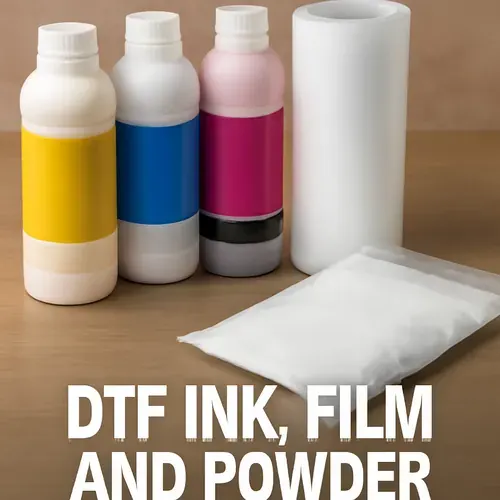
To understand which consumables drive running costs, see our guide to DTF ink, film and powder.
Which DTF printer is right for you?
Match the machine to your stage, not your hopes.
- Learning or hobby use: a desktop A4 or A3 setup is enough.
- Local orders every day (schools, events, small shops): a 30 cm roll printer with good service support.
- High, steady volume or selling transfers to others: a 60 cm machine with a shaker-dryer.
- Selling online and still testing designs: you may not need a machine yet.
If you are comparing DTF with other equipment such as sublimation printers, screen printing setups or vinyl cutters, our list of printing machines for small businesses in India covers the options.
When does using a print-on-demand partner make more sense?
Buying a DTF printer is a good move once volume is steady. Before that point, it ties up money and time in a machine that may sit idle. A print-on-demand partner makes more sense when:
- Your orders are irregular or seasonal, like spikes around Diwali, Onam or college fests.
- You sell online across India and do not want to manage packing and shipping.
- You want to offer many products (T-shirts, hoodies, polos, sweatshirts) without buying stock of each.
- You would rather spend your time on design and marketing.
Many sellers start with a partner, learn which designs sell, and only later decide whether a machine makes sense.
How PrintzyHub helps
PrintzyHub prints with DTF on its own machines, so you get DTF-quality prints without buying a printer, shaker, press or consumables. Sign up free, upload your design, preview it on a product, and sell on your own store or on Amazon, Flipkart, Meesho or Myntra. PrintzyHub prints, checks quality, packs and ships each order under your brand, with no minimum order. See the full product range and current base prices on our catalog page.
Conclusion
Choosing a DTF printer in India is mostly about matching size to volume and making sure service, spares and white ink handling are solid. Look past the machine price to the total cost of ownership. If your orders are not yet steady, a DTF print-on-demand partner lets you start selling now and decide on a machine later with real sales data.
Next step: order a PrintzyHub sample to see DTF print quality on our blanks before you decide whether to buy a machine.
Frequently asked questions
Which DTF printer is best for beginners in India?
For most beginners, an A3 desktop DTF printer or a 30 cm roll-to-roll machine from a seller with strong local service is a sensible start. The best choice is less about the brand and more about head type, white ink circulation, RIP software and how quickly spare parts and support reach your city.
Is it worth buying a DTF printer for a small T-shirt business?
It is worth it when you have steady daily orders, space, and someone to run and maintain the machine. If orders are still irregular or you are testing designs, a print-on-demand partner avoids the machine cost and ongoing consumable and maintenance costs.
What print head is used in DTF printers?
Many DTF printers sold in India use Epson-made print heads. Desktop models are often converted Epson printers, and larger roll-to-roll machines use one or more industrial Epson-type heads. Ask the seller exactly which head is fitted, its replacement cost and whether spares are stocked in India.
Do I need a powder shaker with a DTF printer?
No. Small setups powder and cure by hand using a tray and an oven or heat press. A powder shaker-dryer automates powdering and curing for roll printers and becomes worth it as volume grows, because manual powdering is slow and uneven at scale.
What other equipment is needed besides a DTF printer?
You also need RIP software, a curing oven or shaker-dryer, a heat press, ink, PET film, adhesive powder, blank garments, a stable power supply and ideally an air conditioner or dehumidifier to control humidity.