How to Start a Print on Demand Business in India (2026 Guide)
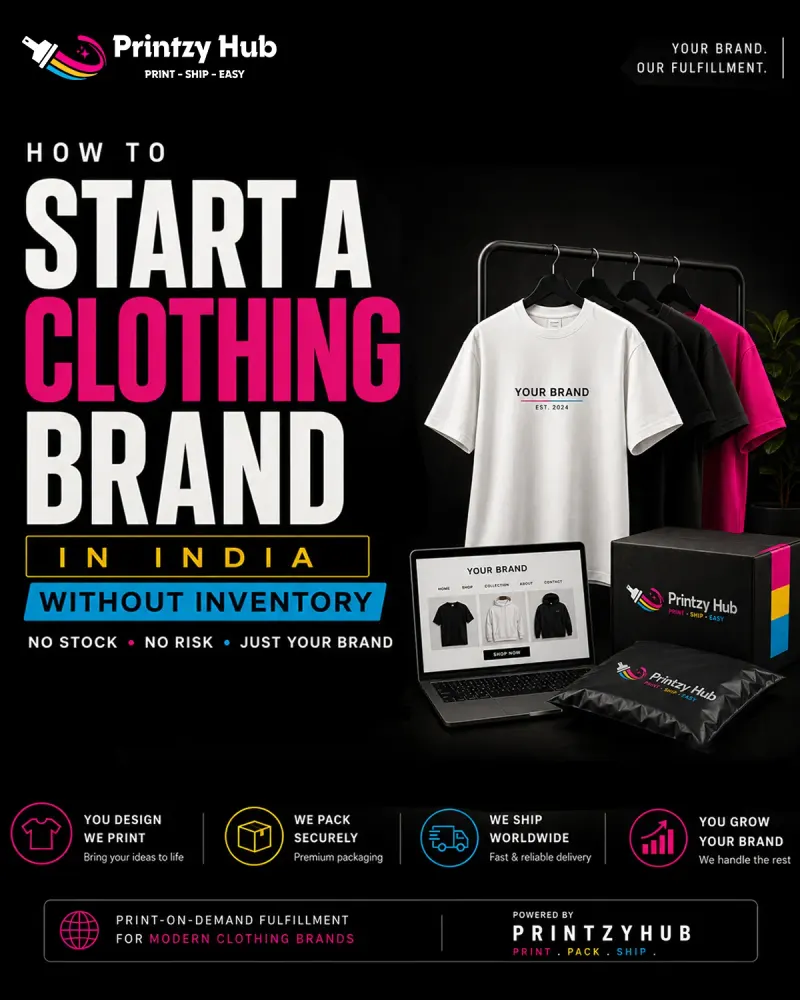
To start a print on demand business in India, pick a clear niche, create designs for that audience, order samples from a print-on-demand partner, price your products with a healthy margin, and list them on your own store, Instagram or marketplaces like Amazon, Flipkart, Meesho and Myntra. When an order comes in, the partner prints, packs and ships it under your brand, so you never buy stock or machines.
This guide walks you through each step in order. If you are new to the model itself, first read what print on demand is and how it works.
What does a print on demand business look like day to day?
Your job is the creative and selling side. Your print partner’s job is production.
| You handle | Your print-on-demand partner handles |
|---|---|
| Niche, designs and brand | Blank garments and printing |
| Your store or marketplace listings | Quality checks |
| Marketing and customer messages | Packing (under your brand if you choose) |
| Pricing and profit | Shipping to your customer |
Because nothing is printed until someone pays, you do not carry the risk of unsold stock. That is why so many students, creators and small shop owners in India start here before moving to bulk orders.
Step 1: Choose a niche you understand
A niche is a specific group of people you design for. “T-shirts for everyone” is hard to market. “Tamil cinema dialogue tees”, “anime oversize tees for college students” or “minimal gym wear for Bengaluru runners” is much easier.
Good ways to find your niche:
- Start with what you know. Your language, city, hobby, job or fandom gives you ideas that outsiders cannot copy easily.
- Check demand. Search Instagram hashtags, Amazon and Meesho listings, and Google search suggestions for your idea.
- Think about occasions. Festivals like Diwali, Pongal and Onam, cricket season, college fests and New Year drive gifting and group orders.
- Stay narrow at first. You can always widen later.
If you are not sure which direction suits you, our list of low investment printing business ideas in India compares several options.
Step 2: Create designs that sell
Designs are your product. The T-shirt is the canvas.
Tools you can use
- Canva for quick text and simple graphic designs.
- Adobe Illustrator, Photoshop or free tools like Inkscape and Photopea for more control.
- Freelance designers if you have ideas but no design skills.
Tips for print-ready artwork
- Upload high-resolution files (a transparent PNG works well for most designs).
- Keep text large enough to read on a phone screen, because most buyers see your product on mobile.
- Think about placement: front chest, full front, back print or sleeve.
- Check contrast: dark designs on dark fabric often disappear.
- Use only artwork you own or have rights to. Movie logos, cricket team logos and brand names can lead to listing removals or legal trouble.
Since PrintzyHub uses DTF (direct-to-film) printing, you can print full-colour artwork, gradients and fine detail without paying for screens or setup.
Step 3: Sort out the legal basics
This part worries many beginners, but the basics are simple. Treat this section as general guidance, not legal advice.
- Business name and bank account. Many people start as a sole proprietor. A separate bank account or UPI ID for the business keeps your accounts clean.
- GST. Whether you need GST registration depends on your annual turnover, whether you sell only within your state or across states, and the platform you use. Selling across states and selling through some marketplaces has historically required registration even at small turnover, while recent changes allow some small sellers to start without one under conditions. The GST rate on clothing can also depend on the sale value. Because these rules change, check the current GST rules on the official GST portal or ask a chartered accountant (CA) before launching.
- Udyam (MSME) registration. Optional but free, and some sellers find it useful later.
- Trademark. Before you fall in love with a brand name, search the trademark registry to make sure it is not already taken. You can apply for your own trademark once you are serious.
Step 4: Choose your products
Start with a small range and do it well. Popular choices for Indian POD brands:
| Product | Who it suits |
|---|---|
| Oversize T-shirt (180 or 240 GSM cotton) | Streetwear, anime, college and Gen Z brands |
| Round neck T-shirt | Everyday wear, quotes, events and group orders |
| Acid washed oversize T-shirt | Vintage and premium streetwear looks |
| Cotton polo / polyester polo | Corporate, teams and uniforms |
| Hoodie and sweatshirt | Winter collections and North India markets |
You can see every product and its current base price on our catalog and pricing page. Base price is what you pay for production; it is the starting point for your own selling price.
Step 5: Order samples before you sell
Never sell a product you have not touched. A sample lets you check:
- Fabric feel and thickness
- Size and fit (compare against the size chart)
- Print colours, sharpness and wash results
- Packing and how the parcel looks on arrival
Samples also give you real photos for Instagram and your listings, which perform far better than plain mockups. You can buy a single sample on PrintzyHub before going bulk. Samples are charged at the normal price plus shipping.
Step 6: Price your product so you actually make money
This is where many new sellers go wrong. They copy a competitor’s price without checking their own costs.
Step-by-step pricing method
- Production cost: the base price of the printed product from your partner.
- Shipping cost: what you pay to deliver to the customer (or the marketplace fee and shipping deduction).
- Platform fees: marketplace commission, payment gateway charges, or Shopify app costs.
- Marketing cost per sale: if you spend on ads, divide your ad spend by the number of orders.
- Returns and COD risk: keep a buffer for returned or refused COD parcels.
- Your margin: what is left after everything above.
The simple formula is:
Profit per piece = Selling price − (production + shipping + fees + marketing + return buffer)
Margin % = Profit per piece ÷ Selling price × 100
Remember that GST, if you are registered, affects what you actually keep from the selling price. To run your own numbers quickly, use the profit calculator on our home page. For a detailed worked example, read is custom T-shirt printing a profitable business.
Step 7: Decide where to sell
You do not need to be everywhere on day one. Pick one or two channels and learn them properly.
| Channel | Good for | Things to know |
|---|---|---|
| Own store (Shopify or WooCommerce) | Brand building, higher margin, repeat customers | You bring your own traffic |
| Instagram (and WhatsApp) | Fast start, direct relationship with buyers | Needs regular content; orders often come through DMs |
| Amazon | Search traffic and trust | Fees, listing rules, GST requirements |
| Flipkart | Large audience across India | Similar to Amazon; competitive pricing |
| Meesho | Price-sensitive buyers, smaller towns | Lower selling prices, so watch your margin |
| Myntra | Fashion-focused shoppers | Stricter brand and quality standards |
Many sellers start with Instagram plus a simple website, then add marketplaces once they have tested which designs sell. Our guide on building a custom printing brand online from scratch covers setting up your store, photos and listings in detail. PrintzyHub’s eCommerce and marketplace support can help with order handling on these platforms.
Step 8: Build your brand, not just a shop
People buy from brands they recognise. Even a small POD business benefits from:
- A clear brand name and logo
- Consistent colours and photo style
- Branded neck labels, tags and packaging
- A short story about why the brand exists
If you want your customers to see only your brand, not ours, look at customised branding for labels and packaging. For a full walkthrough of naming, identity and your first collection, read how to start a clothing brand in India without inventory.
Step 9: Market your designs
Marketing is the part you cannot outsource to your print partner. A simple plan:
- Post regularly on Instagram. Reels showing the product, unboxing, design process and customer photos work better than plain product images.
- Work with small creators. Micro-influencers in your niche often bring better results than big names.
- Use WhatsApp. Broadcast lists and status updates work well in India for repeat customers.
- Plan around festivals and events. Launch a themed drop before Diwali, Valentine’s Day, college fest season or a big cricket series.
- Try paid ads only after organic posts show which designs people like. Then put money behind the winners.
For a deeper plan, see our guide to marketing your printing business on Instagram and through paid ads.
Step 10: Scale what works
Once you have steady orders, growth comes from doing more of what already works.
- Find your best sellers. Make colour and product variations of designs that already sell.
- Add products. A design that sells as an oversize tee may also sell as a hoodie or sweatshirt.
- Collect reviews and customer photos. They make every future sale easier.
- Consider bulk for proven designs. When a design sells consistently, ordering in bulk can lower your cost per piece. PrintzyHub offers both single-piece POD and bulk production, so you can switch without changing partners.
- Take on group orders. Colleges, gyms, startups and event organisers need custom T-shirts and pay well for reliability.
Common mistakes to avoid
- Launching with 50 designs instead of 5 to 10 strong ones.
- Skipping samples and getting surprised by fit or colour.
- Pricing too low to compete and losing money once fees and returns are counted.
- Using copyrighted logos or characters.
- Ignoring customer messages. Fast replies build trust, especially for COD buyers.
How PrintzyHub helps
PrintzyHub is a print-on-demand and dropshipping partner for apparel in India, run by MV INC from Tiruppur, Tamil Nadu. In practice:
- No minimum order. Order one T-shirt or a bulk batch.
- Simple flow. Sign up free on the app, pick a product, upload artwork, preview it, and sell. We print with DTF, run quality control on every order, pack and ship under your brand.
- Same-day dispatch, COD for vendors. Orders are dispatched the same day, and cash on delivery is available for sellers registered as vendors on the PrintzyHub app.
- Wide range. Oversize, acid washed, round neck, polos, shirts, hoodies, sweatshirts and track pants.
- Extra help when you need it. Customised labels and packaging, design and branding help, and marketplace order support.
- Human support. WhatsApp +91 76958 35511 or [email protected], Monday to Saturday, 9 AM to 6:30 PM IST, in Tamil, English and Hindi, plus YouTube tutorials and weekly webinars.
Conclusion
Starting a print on demand business in India is mostly about good decisions in the right order: a focused niche, designs your audience actually wants, samples you have checked, a price that leaves a real margin, and consistent marketing on one or two channels. The printing, packing and shipping can be handed to a partner from day one.
Ready to begin? Sign up free on the PrintzyHub app, check current base prices on our pricing page, and order your first sample.
Frequently asked questions
How much money do I need to start a print on demand business in India?
Much less than a traditional clothing business, because you do not buy stock or machines. Your main early costs are a few samples, a domain or store subscription if you use one, and some money for marketing. Many sellers start on Instagram or a marketplace and add a website later.
Do I need GST registration to sell T-shirts online in India?
It depends on your turnover, whether you sell within your state or across states, and which platform you sell on. Many marketplaces ask for a GSTIN, although some now allow small sellers to start without one under certain conditions. Rules change, so check the current GST rules or speak to a chartered accountant before you start.
Can I start a T-shirt business from home in India?
Yes. With print on demand, you only need a phone or laptop, your designs and a place to sell. The print-on-demand partner prints, packs and ships each order, so you do not need space for stock or machines at home.
Is print on demand good for beginners?
Yes, it is one of the safest ways to start because you only pay for production after a customer orders. You can test many designs without leftover stock. The trade-off is a lower margin per piece than bulk production, so pricing carefully matters.
How long does it take to start a print on demand business?
You can set up an account, upload designs and order samples within a few days. Building steady sales takes longer, usually months of posting, testing designs and learning what your audience buys.