Best Print on Demand Platform in India: A Startup Buyer's Guide
Part of our guide: What Is Print on Demand and How Does It Work in India?
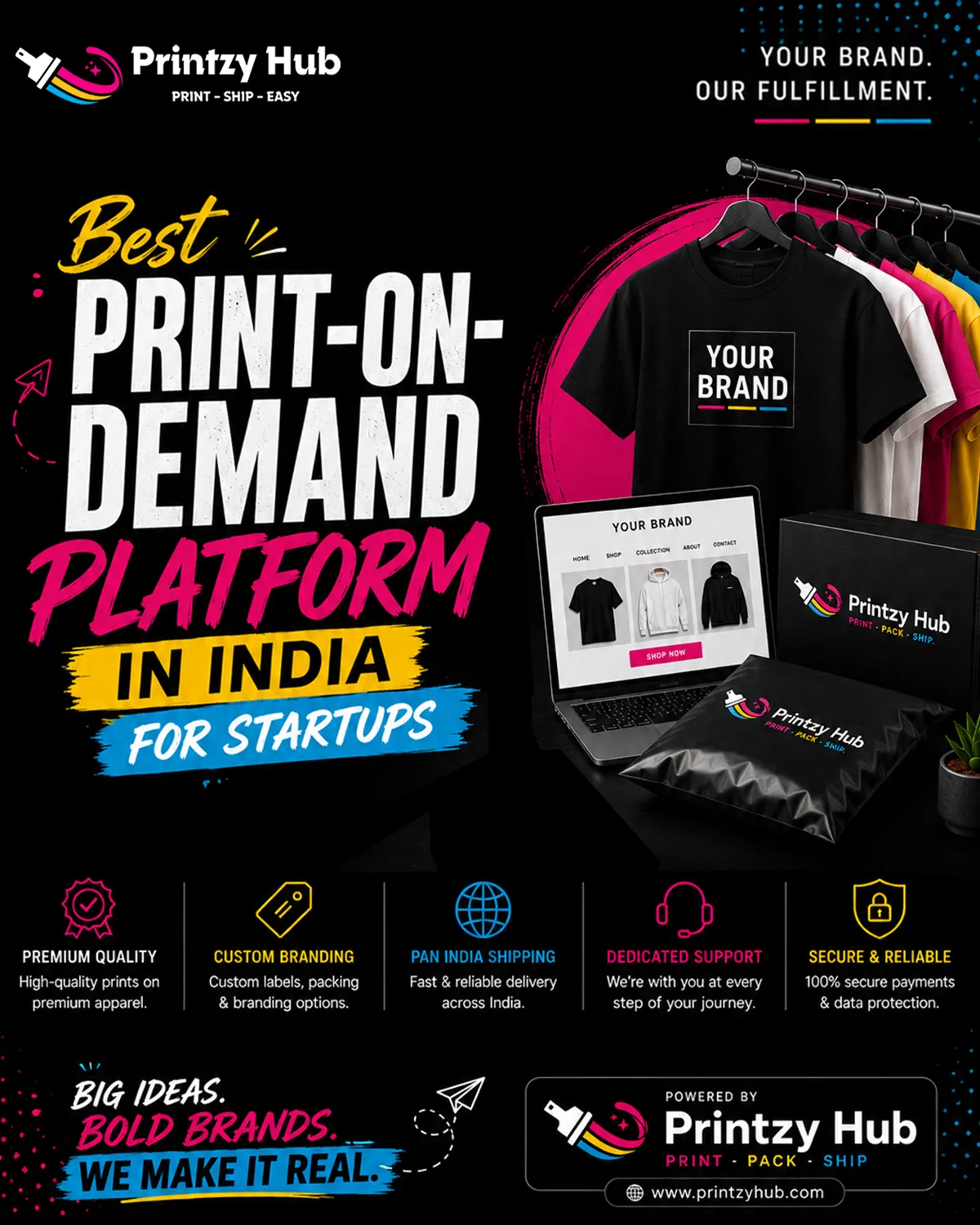
The best print on demand platform in India is the one that prints the products you want to sell, at consistent quality, with no minimum order, and fulfils orders from the marketplaces you sell on. There is no single winner for every seller. Instead of trusting “top 10” lists, compare platforms on the ten points below, order a sample, and ask the questions at the end of this guide.
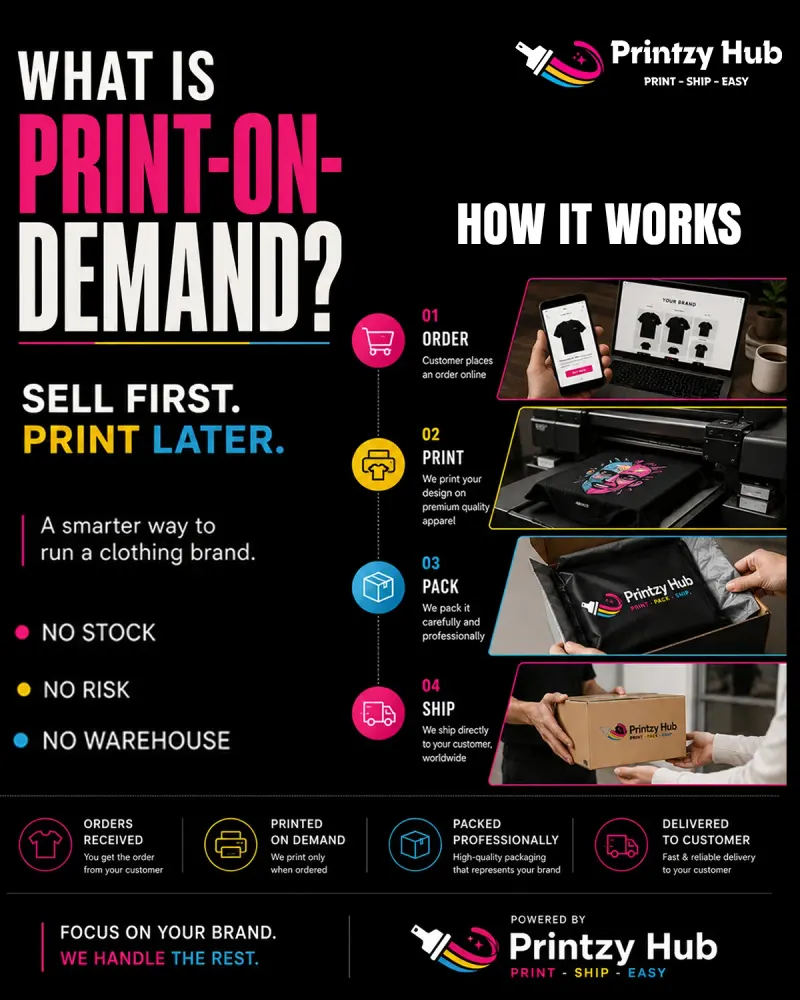
If you are new to the model itself, start with our explainer on what print on demand is and how it works.
Why does choosing the right POD platform matter so much?
Your POD platform is your factory, warehouse and shipping team. Your customer never sees them, but they feel every decision the platform makes: the fabric, the print, the packing and the delivery time. A bad print or a late parcel becomes a bad review for your brand, not theirs.
Switching later is possible, but it means new samples, new listings and new photos. So it is worth spending a week comparing properly at the start.
What should you compare in a print on demand platform?
1. Product range and fabric
Check whether they offer the exact styles your audience buys: oversized tees, acid-washed styles, hoodies, polos, track pants. Ask for the fabric details, especially GSM (fabric weight). A 240 GSM oversized T-shirt feels heavier and more premium than a 180 GSM one, and buyers notice.
2. Printing method and print quality
Ask which printing method they use. DTF (direct-to-film) is common for POD because it prints full-colour designs well on single pieces. DTG and sublimation are also used, each with its own strengths. Then look at a real print: colour accuracy, sharpness of fine lines, how it feels, and how it looks after a few washes. Our guide to DTF vs DTG vs screen printing explains the differences.
3. Minimum order quantity (MOQ)
For a startup, no minimum order is the ideal. You should be able to print one piece when one customer orders. Also check whether they can handle bulk orders later, so you do not need to change partners when you grow.
4. Marketplace integration
Most Indian sellers sell on at least one of Amazon, Flipkart, Meesho or Myntra. Ask how the platform handles orders from each one: do they support marketplace shipping labels, invoice requirements and dispatch timelines?
5. Branding and packaging
Can they ship under your brand name? Look for custom neck labels, branded packaging, thank-you cards and no platform name on the parcel. This is what turns a T-shirt into a brand.
6. Shipping coverage and COD
Check pin code coverage (including tier 2 and tier 3 towns), typical dispatch time, and how shipping is charged. If you take orders through Instagram or your own site, ask how COD and return-to-origin (RTO) parcels are handled and charged.
7. Returns and reprint policy
Defects happen in any production. What matters is the policy: will they reprint a misprinted or damaged piece? How do you report it? Are size exchanges handled differently from defects?
8. Support language and hours
When an order is stuck, you need a human who answers. Check the channels (WhatsApp, phone, email), working hours, and the languages they support. Support in your own language saves a lot of confusion.
9. Samples
Any serious platform should let you buy a sample before you sell. Wear it, wash it three or four times, and photograph it for your listings.
10. Pricing transparency
Look at the full cost per order, not just the base price: printing, shipping, branding add-ons, and any monthly or listing fees. Then work out your margin with a simple formula (selling price minus all costs and marketplace fees).
POD platform comparison checklist
Use this table when you compare two or three platforms. Fill in one column per platform.
| What to check | What a good answer looks like | Platform A | Platform B |
|---|---|---|---|
| Product range | The exact styles your audience buys, with GSM listed | ||
| Print method | Clearly stated (DTF, DTG, sublimation) | ||
| Print quality | Sample looks sharp and survives 3–4 washes | ||
| Minimum order | One piece, with bulk available later | ||
| Marketplaces | Supports the ones you sell on | ||
| Branding | Your labels and packaging, no platform name | ||
| Shipping & COD | Wide pin code coverage, clear RTO charges | ||
| Defect policy | Reprint or replace, clear reporting process | ||
| Support | WhatsApp/email, fixed hours, your language | ||
| Samples | Single sample available before selling | ||
| Pricing | Full per-order cost visible, no hidden fees |
What questions should you ask any print on demand platform?
Copy these into a WhatsApp message or email before you sign up:
- What is the GSM and fabric composition of each blank I want to sell?
- Which printing method do you use, and how should customers wash the product?
- Is there any minimum order, for single pieces and for bulk?
- How do you handle orders from Amazon, Flipkart, Meesho and Myntra?
- Can you ship with my brand’s labels and packaging?
- What is your usual production and dispatch time?
- How are COD orders and RTO parcels charged?
- What is your process if a print is defective or the wrong item is sent?
- What are your support hours and languages?
- Can I order one sample first, and what does shipping cost?
A platform that answers these clearly and quickly is usually the one that will also handle problems well.
Where does PrintzyHub fit?
PrintzyHub is a print-on-demand and dropshipping partner for apparel, run by MV INC from Tiruppur, Tamil Nadu. Here is how it maps to the checklist, so you can compare it fairly with others:
-
Product range: oversize T-shirts (180 and 240 GSM cotton), acid-washed oversize tees, sleeveless and track pants, round necks, cotton, polyester and pocket polos, shirts, denim shirts, sweatshirts, hoodies, acid-washed oversized hoodies and zipper hoodies. See the full product catalogue.
-
Print method: DTF printing.
-
Minimum order: none. Order one piece or a bulk batch.
-
Marketplaces: sell on your own store or on Amazon, Flipkart, Meesho or Myntra; PrintzyHub prints, packs and ships under your brand. There is also eCommerce and marketplace order support.
-
Branding: custom labels and packaging through customised branding.
-
Quality: quality control on every order before dispatch.
-
Samples: you can order a single sample to check fabric, fit, print and packing (no bulk discount on samples, shipping charged).
-
Support: WhatsApp +91 76958 35511 and [email protected], Monday to Saturday, 9 AM to 6:30 PM IST, in Tamil, English and Hindi, plus YouTube tutorials and weekly webinars.
-
Pricing: base prices are shown on the pricing page after a free mobile sign-up.
-
Dispatch: orders are dispatched the same day.
-
Cash on delivery: COD is available for sellers registered as vendors on the PrintzyHub app.
-
Defects: if you find a printing defect (wrong print, misalignment, colour mismatch or a damaged piece), report it through your dashboard or our support team within the support window. Once the quality team verifies it as a production error, we reprint, replace or resolve it as per our quality policy.
-
Printing: DTF printing only.
How do you make the final decision?
- Shortlist two or three platforms that carry your products and support your marketplaces.
- Order the same product from each as a sample.
- Wash, wear and compare them side by side.
- Send the ten questions and judge the answers and the response speed.
- Calculate your margin with each platform’s real costs.
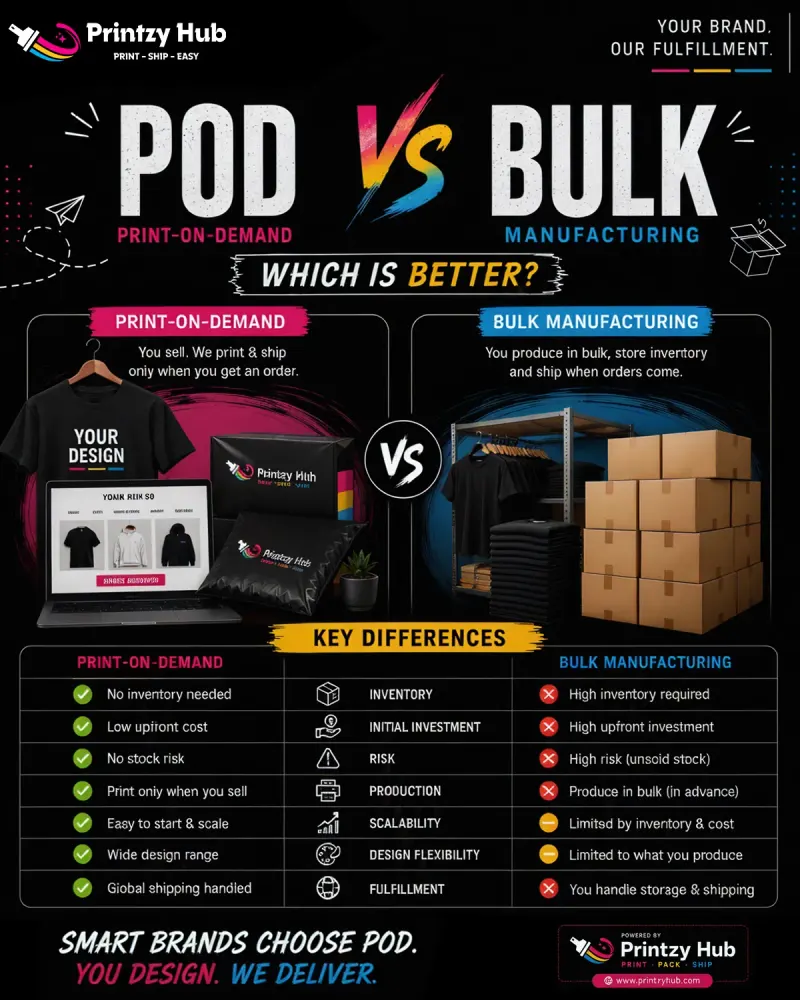
Then pick one and start. You can always move high-selling designs to bulk later; our guide on print on demand vs bulk manufacturing explains when that makes sense. For the full launch plan, read how to start a print-on-demand business in India.
Conclusion
The best print on demand platform in India for your startup is the one that passes your own checklist: right products, consistent print quality, no minimum order, support for your marketplaces, your branding, and clear answers when something goes wrong. Test with samples, not promises.
Next step: sign up free on PrintzyHub to see current base prices, and order a sample to compare it with any other platform you are considering.
Frequently asked questions
Which is the best print on demand company in India?
There is no single best one for everyone. The right platform is the one that prints the products you want, supports the marketplaces you sell on, has no or low minimum order, and gives consistent print quality. Order samples from two or three platforms and compare them side by side before deciding.
Can I use a print on demand platform to sell on Meesho?
Yes, many Indian POD platforms let you fulfil marketplace orders, including Meesho, Flipkart, Amazon and Myntra. Each marketplace has its own rules on dispatch time, labels and packaging, so confirm with the platform how they handle that marketplace's orders before you list.
Do print on demand platforms in India offer cash on delivery?
On marketplaces, COD is handled by the marketplace itself. For orders from your own website or Instagram, it depends on the platform and your payment setup. Ask how COD orders, failed deliveries and return-to-origin parcels are charged, because COD returns can eat into your margin.
Is it free to join a print on demand platform?
Most Indian POD platforms are free to join, and you pay only when an order is printed. Check whether there are any monthly fees, listing fees or charges for branding add-ons like custom labels and packaging.
What happens if a print on demand order arrives with a defect?
A good platform will reprint or replace items with printing or manufacturing defects. Ask what counts as a defect, how quickly you must report it, and what proof (photos or unboxing video) they need. Size exchanges are usually treated differently from defects.