What Is Print on Demand and How Does It Work in India?
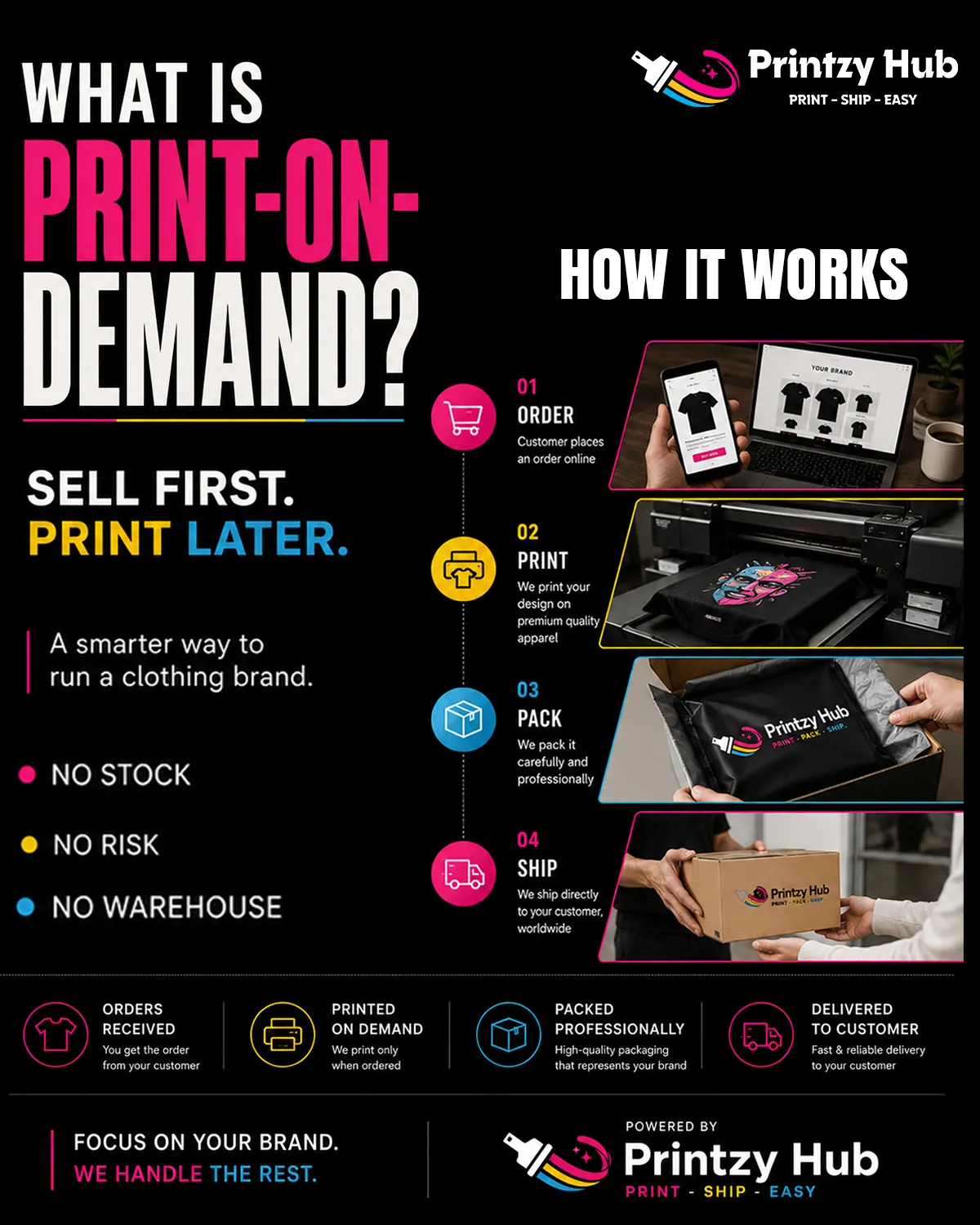
Print on demand (POD) is a way of selling custom products where nothing is made until a customer pays for it. You upload your design, list the product, and when an order comes in, a print-on-demand partner prints that single piece, packs it and ships it to your customer. In India, this means you can start a T-shirt or clothing brand without buying stock, machines or a warehouse.
This guide explains how print on demand works step by step, what it really costs you, where it fits in the Indian market, and when it is (and is not) the right model.
What does print on demand mean, in simple words?
In a normal clothing business, you order a few hundred T-shirts, print them, store them and hope they sell. If a design flops, the money is stuck in unsold stock.
Print on demand flips that order:
- You create the design first.
- You sell it online.
- Only after a customer orders is the product printed and shipped.
You never hold inventory. The POD partner owns the blank stock, the printing machines and the packing, and charges you a base price for each piece they make. You set your own selling price, and the difference is your margin.
Print on demand vs dropshipping
People often mix these up. Dropshipping means a supplier sends ready-made products directly to your customer. Print on demand is a kind of dropshipping, but the product is printed with your design after each order. That difference matters: with POD you are building your own brand, not reselling a generic product that a hundred other sellers also list.
How does print on demand work, step by step?
Here is how a typical order moves through a print-on-demand system in India.
Step 1: Sign up with a POD partner
Choose a partner that prints the products you want to sell and ships across India. Signing up is usually free. You get access to their product catalogue, base prices and design tools.
Step 2: Pick a product and upload your design
Choose a blank, for example a 180 GSM or 240 GSM oversize T-shirt, a hoodie or a polo. Upload your artwork (a high-resolution PNG with a transparent background works best), position it on the mockup, and check the preview.
Step 3: List the product where you sell
You can sell on:
- Your own channels: Instagram, WhatsApp, or your own website.
- Indian marketplaces: Amazon, Flipkart, Meesho or Myntra.
You set the selling price, sizes and colours. Take good mockup photos or, better, real photos of a sample you have worn.
Step 4: A customer places an order
The order details (product, size, colour, design, delivery address) reach your POD partner, either through an integration or when you place the order on their app.
Step 5: The partner prints, checks and packs
The blank is printed with your design. Many Indian POD partners use DTF (direct-to-film) printing for this, because it handles full-colour designs well on cotton and blends, and works for single pieces. A good partner checks the print and stitching before packing, and can pack under your brand name.
Step 6: The order is shipped to your customer
The parcel goes to your customer’s address with tracking. To the customer, it looks like it came from your brand.
Step 7: You get paid
Your customer pays you (or the marketplace pays you after its settlement cycle). You pay the POD partner the base cost and shipping for that piece. What is left, after marketplace fees and taxes, is your profit.
What are the benefits of print on demand?
| Benefit | What it means for you |
|---|---|
| No inventory | No money stuck in unsold T-shirts, no storage space needed |
| No machines | No need to buy a DTF printer, heat press or dryer |
| Low risk testing | Try 20 designs and keep only the ones that sell |
| No minimum order (with some partners) | Sell one piece at a time from day one |
| Time for marketing | Printing, packing and shipping are handled for you |
| Easy to expand | Add hoodies for winter or polos for corporate orders without new stock |
For an Instagram seller in Chennai or a college student in Pune, the biggest benefit is simple: you can launch a brand this week with only your designs and your phone.
What are the downsides of print on demand?
POD is not perfect. Be honest with yourself about these points before you start:
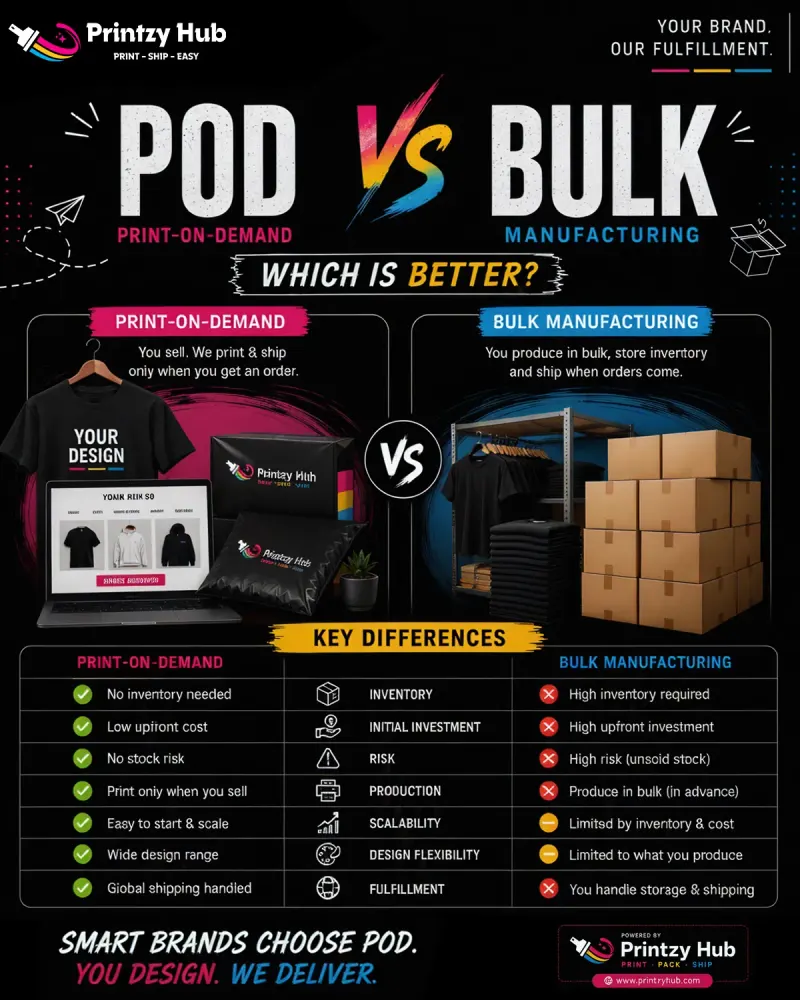
- Lower margin per piece. Printing one piece costs more than printing 500 in a batch. You trade per-piece margin for zero stock risk.
- Less control over production. You depend on your partner’s print quality, stock availability and dispatch speed.
- Shipping time includes production. Each piece is made after the order, so delivery can take a little longer than shipping from your own shelf.
- Competition. Because starting is easy, many sellers use similar designs. Original designs and good branding matter more than ever.
- Returns cost you. A wrong-size return still costs shipping and the printed piece. Clear size charts reduce this a lot.
If you later have designs that sell steadily, you can move those to bulk production for a better margin. We compare both models in detail in our guide on print on demand vs bulk manufacturing.
How much does it cost to start print on demand in India?
The startup cost is mostly time and marketing, not stock. Here is what you actually spend money on:
- Samples: order one or two pieces to check fabric, fit and print before you sell. This is the one cost no serious seller should skip.
- Design: free if you design yourself in Canva or similar tools; paid if you hire a designer.
- Marketing: Instagram ads, influencer posts, or photography.
- Marketplace setup: GST registration and marketplace fees if you sell on Amazon, Flipkart, Meesho or Myntra.
How to calculate your profit per piece
Use this simple formula for each product:
Profit = Selling price − (base product cost + shipping + marketplace commission and fees + payment/COD charges + GST + an allowance for returns)
Work it out on paper before you set your price. You can also try the profit calculator on our home page. For current product base prices, see our catalogue and pricing page.
Which products work best for print on demand in India?
Apparel is the most popular POD category in India. Some guidance by product:
- Oversize T-shirts: the strongest seller with 18–30 year olds. Heavier 240 GSM fabric feels more premium.
- Acid-washed T-shirts and hoodies: a streetwear look that stands out on Instagram. See the acid-washed oversize T-shirt.
- Round neck T-shirts: a classic choice for events, colleges and simple quote designs.
- Hoodies, zipper hoodies and sweatshirts: strong sellers from October to February, especially in North India.
- Cotton and polyester polos: good for corporate, team and school orders. Polyester polos are quick-dry and suit sports teams.
Festivals like Diwali, Onam, Pongal and Navratri, plus college fests and cricket seasons, create short demand spikes. POD lets you launch a themed design in days without guessing how much stock to buy.
Who should use print on demand?
Print on demand suits you if you are:
- An Instagram creator or influencer who wants merch without handling stock.
- A student or first-time founder testing a clothing brand idea with little money.
- A marketplace seller who wants to add custom apparel to Amazon, Flipkart, Meesho or Myntra.
- A small business, gym, café or college club that needs branded T-shirts in small numbers.
- A designer or artist who wants to sell their art on wearable products.
It suits you less if you already sell hundreds of pieces of one design every month; at that point, bulk printing usually gives better margins.
How do you choose a print-on-demand partner in India?
Not all POD partners are the same. Before you commit, compare:
- Product range and fabric GSM
- Printing method and how prints hold up after washing
- Minimum order (ideally none)
- Whether they support your marketplace (Amazon, Flipkart, Meesho, Myntra)
- Branding: custom labels and packaging
- Shipping coverage and COD options
- Return and reprint policy for printing defects
- Support language and response hours
- Whether you can buy a sample first
We have written a full checklist with questions to ask any platform in our guide to choosing the best print-on-demand platform in India.
How PrintzyHub’s print on demand works
PrintzyHub is a print-on-demand and dropshipping partner for apparel, run by MV INC from Tiruppur, Tamil Nadu. Here is how it works:
- Sign up free on the PrintzyHub app.
- Pick a product, upload your artwork and preview it. The range includes oversize T-shirts in 180 and 240 GSM cotton, acid-washed tees, sleeveless and track pants, round necks, cotton, polyester and pocket polos, shirts, denim shirts, sweatshirts and three hoodie styles.
- Sell on your own store or on Amazon, Flipkart, Meesho or Myntra.
- PrintzyHub prints, packs and ships to your customer under your brand.
A few things that are useful to know:
- No minimum order. You can order one printed T-shirt or a bulk batch.
- DTF printing is used for all designs.
- Quality control on every order before it is packed.
- Same-day dispatch of orders.
- Cash on delivery is available for sellers registered as vendors on the PrintzyHub app.
- Printing defects reported through your dashboard or support are checked by our quality team, and verified production errors are reprinted or replaced.
- Customised branding: your labels and packaging, through our customised branding service.
- Samples: you can buy a single sample to check fabric, fit, print and packing before you sell or go bulk.
- Support on WhatsApp (+91 76958 35511) and email ([email protected]), Monday to Saturday, 9 AM to 6:30 PM IST, in Tamil, English and Hindi, plus YouTube tutorials and weekly webinars.
If you also need help with designs or marketplace listings, see our design and branding and eCommerce support services.
Is print on demand right for you?
Ask yourself three questions:
- Do I have designs or an audience? POD handles production, not demand. You still need to find buyers.
- Am I fine with a smaller margin per piece in exchange for no stock risk? For most beginners, yes.
- Am I ready to test and drop designs quickly? The sellers who do well treat each design as an experiment.
If the answer is yes, print on demand is the safest way to start. Our complete guide to starting a print-on-demand business in India walks you through niche, designs, GST, marketplaces and your first marketing plan.
Conclusion
Print on demand lets you sell custom apparel in India without stock, machines or a minimum order. You focus on designs and marketing; your partner prints, packs and ships each order after it is placed. Margins per piece are lower than bulk, but the risk is close to zero, which makes it the best way to test a brand idea.
Next step: order a sample to see the quality for yourself, then sign up free on PrintzyHub and list your first design.
Frequently asked questions
Is print on demand profitable in India?
It can be, if you price correctly and market well. Your profit per piece is your selling price minus the base product cost, printing, shipping, marketplace fees and GST. Margins per piece are lower than bulk, but you take almost no stock risk, so profit depends mostly on how many orders your marketing brings in.
Do I need GST registration to start print on demand in India?
If you sell only through your own website or Instagram and stay under the turnover limit, you may not need it at the start. Most marketplaces such as Amazon, Flipkart, Meesho and Myntra ask for a GST number before you can list products. Check the current rules with a CA, because thresholds and marketplace requirements change.
Can I do print on demand without a website?
Yes. Many Indian sellers start on Instagram or WhatsApp and take orders through DMs, or list directly on marketplaces like Meesho, Flipkart or Amazon. A website helps later for brand building, but it is not required to get your first orders.
What is the difference between print on demand and dropshipping?
Dropshipping means a supplier ships ready-made products to your customer so you never touch stock. Print on demand is a type of dropshipping where the product is printed with your design only after the order comes in. With POD the design is yours, so you are building a brand, not reselling someone else's product.
How long does a print on demand order take to reach the customer?
It depends on the provider's production time and the courier route. Production adds a short step before dispatch because each piece is printed after the order. Ask your provider for current production and shipping timelines for your target cities before you promise delivery dates to customers. PrintzyHub dispatches orders the same day, so delivery time is mostly the courier route.
Which products sell best with print on demand in India?
T-shirts are the easiest start, especially oversized and acid-washed styles for younger buyers. Hoodies and sweatshirts sell well in winter and in North India, and polo T-shirts work for corporate and team orders. Test a few designs on one or two products before adding more.