How to Start a Clothing Brand in India Without Inventory
Part of our guide: How to Start a Print on Demand Business in India (2026 Guide)
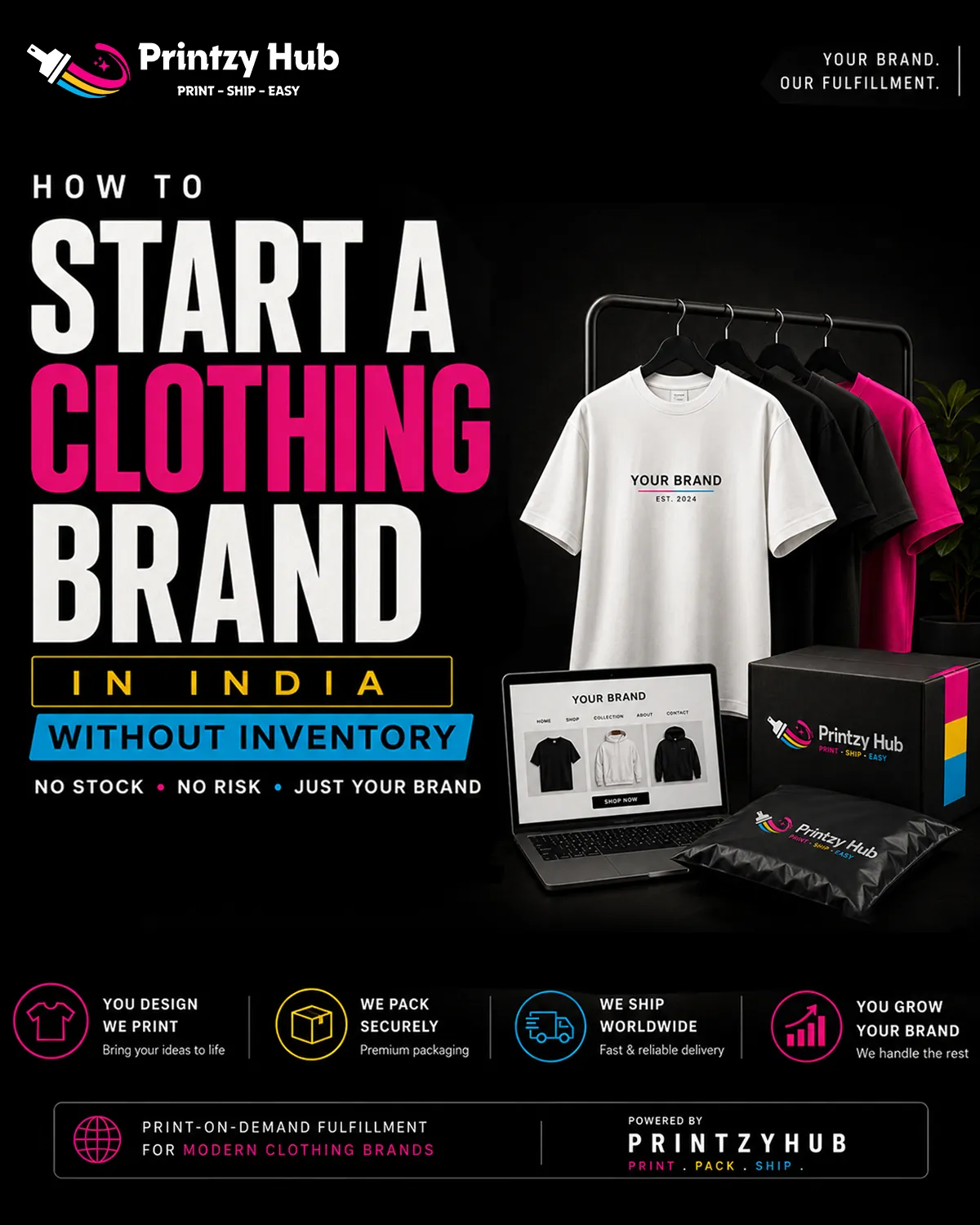
You can start a clothing brand in India without inventory by owning the brand while a print-on-demand partner owns production. You build the name, identity, designs and audience; every T-shirt is printed only after a customer orders, then packed with your labels and shipped to them. You never buy bulk stock, and you can sell T-shirts online without stock from your own store, Instagram or marketplaces.
This guide is about the brand side: what makes people remember and trust your label. For the full operational checklist (GST, pricing, channels and scaling), see our pillar guide on how to start a print on demand business in India.
Why build a brand instead of just selling T-shirts?
Thousands of sellers list similar printed tees. A brand gives buyers a reason to pick you.
| Generic T-shirt seller | Clothing brand |
|---|---|
| Random designs for everyone | One clear audience and style |
| Competes mostly on price | Can charge for identity and quality |
| Customers rarely come back | Repeat buyers and word of mouth |
| Plain parcel and printer labels | Your labels, tags and packaging |
When you sell on demand, your per-piece cost is usually higher than bulk. A strong brand helps you charge a price that covers it.
Step 1: Decide who your brand is for
Before the logo, decide the person. Write one sentence like: “Oversize anime tees for college students in Chennai and Hyderabad who want something better than fast fashion.”
Answer these questions:
- Who exactly buys from you (age, city, interests)?
- What do they wear now, and what annoys them about it?
- Where do they spend time online?
- What would make them proud to wear your brand?
This sentence guides every later choice: name, colours, designs and where you sell.
Step 2: Choose a brand name that can grow
A good clothing brand name is:
- Short and easy to say in English and in your audience’s language.
- Easy to spell so people can find you on Instagram and Google.
- Not tied to one product (“Thread Story” can sell hoodies later; “Best Tee Shop” cannot).
- Available. Check the Instagram handle, a domain name and the trademark registry before you decide.
Avoid names close to famous brands. It invites legal notices and confuses buyers.
Step 3: Build a simple brand identity
You do not need an expensive agency. You need consistency.
Logo
Keep it simple enough to work as a small neck label print and as an Instagram profile picture. A wordmark (your name in a clean font) is often enough at the start.
Colours and fonts
Pick 2 or 3 brand colours and 1 or 2 fonts. Use them on your website, posts, size charts and packaging.
Voice
Decide how your brand talks. Playful and full of memes? Calm and premium? Tamil or Hindi words mixed in? Stay consistent in captions, product descriptions and WhatsApp replies.
If you want help, PrintzyHub’s design and branding service can support you with logo and brand assets.
Step 4: Make the product feel like yours
This is the step that separates a brand from a reseller. With print on demand, you can still control what the customer touches.
- Neck labels and tags with your brand name instead of a generic label.
- Branded packaging so the unboxing feels like your brand.
- Thank-you cards or inserts with your Instagram handle or a discount code for the next order.
PrintzyHub offers customised branding for labels and packaging, so the parcel your customer receives carries your brand, not ours.
Step 5: Plan your first collection
Launch with a collection, not a pile of unrelated designs.
How to plan it
- Pick one theme. For example, “Madras Nights”, “Gym Rat Series” or ”90s Cricket Nostalgia”.
- Create 5 to 10 designs that clearly belong together.
- Choose 1 or 2 products. An oversize T-shirt works well for streetwear; a round neck suits everyday and quote designs.
- Choose a few colours that match your brand and look good with the prints.
- Order samples of your top designs to check print, fit and packing. You can buy a single sample before launch.
Timing matters
Indian buying seasons help small brands. Plan drops for Diwali gifting, Pongal or Onam, Valentine’s Day, college fest season, and winter (a good time to add a hoodie or sweatshirt).
Step 6: Sell T-shirts online without stock
Once the collection is ready, you list it. No stock is needed at any point.
- Upload artwork to your print-on-demand partner’s app and preview it on the product.
- List the products on your store, Instagram shop, or marketplaces such as Amazon, Flipkart, Meesho or Myntra.
- Customer orders and pays (prepaid or COD, depending on your setup).
- The order goes to your partner, who prints, quality-checks, packs and ships it under your brand.
- You handle the customer with updates, questions and follow-ups.
Your money goes into samples, photos and marketing, not into boxes of T-shirts that may never sell. For the store and listing setup itself, read building a custom printing brand online from scratch.
Step 7: Launch with a story
People share brands that mean something. Before launch day:
- Tease the collection on Instagram for one or two weeks with sketches, sample photos and behind-the-scenes Reels.
- Tell the “why” behind the brand in a short post or video.
- Get the first customers from your network, then ask them for photos and reviews.
- Give early buyers a small reason to talk, such as a thank-you card or a code for their friends.
Our guide to marketing your printing business on Instagram and through paid ads covers content and ads in depth.
Common brand mistakes to avoid
- Changing your logo, colours and style every month.
- Launching too many unrelated designs at once.
- Copying trending designs from bigger brands.
- Spending on ads before you have good product photos.
- Forgetting the unboxing. A plain parcel wastes your best branding moment.
How PrintzyHub helps you build your brand
- No minimum order, so each new design costs you nothing until it sells.
- Customised branding for labels and packaging under your name.
- DTF printing and quality control on every order, so your brand’s reputation is protected.
- A wide product range to grow from tees into polos, shirts, hoodies and track pants. See all products and current base prices on our catalog page.
- Support in Tamil, English and Hindi on WhatsApp and email, plus tutorials and weekly webinars.
Conclusion
A clothing brand without inventory is still a real brand. Focus on who you serve, give the brand a clear name and look, make the product feel like yours with labels and packaging, and launch a small, themed collection with a story. Let your print-on-demand partner take care of stock and shipping.
Start by signing up free on the PrintzyHub app and ordering a sample of your first design.
Frequently asked questions
Can I start a clothing brand in India with no stock?
Yes. With print on demand, every piece is printed only after a customer orders it, so you hold no stock. You still own the brand, designs, pricing and customer relationship, while the partner handles printing, packing and shipping.
Will customers know my T-shirts are made by a print-on-demand company?
Not if you use branded labels and packaging. With customised branding, the neck label, tags and parcel can carry your brand name instead of the printer's, so the customer only sees your brand.
How many designs should my first clothing collection have?
Most new brands do well with 5 to 10 designs built around one theme. A small, focused drop is easier to photograph, explain and promote, and it tells you quickly which styles your audience likes.
Do I need to register a trademark before launching my clothing brand?
It is not required to start selling, but you should at least search the trademark registry to make sure your name is not already used in clothing. Applying for a trademark early protects you if the brand grows. A trademark agent or lawyer can guide you.
What is the difference between a clothing brand and a T-shirt shop?
A shop sells random designs to anyone. A brand has a clear audience, a consistent look and a reason people choose it again. Brands can charge more and get more repeat customers, which matters a lot when you sell on demand.